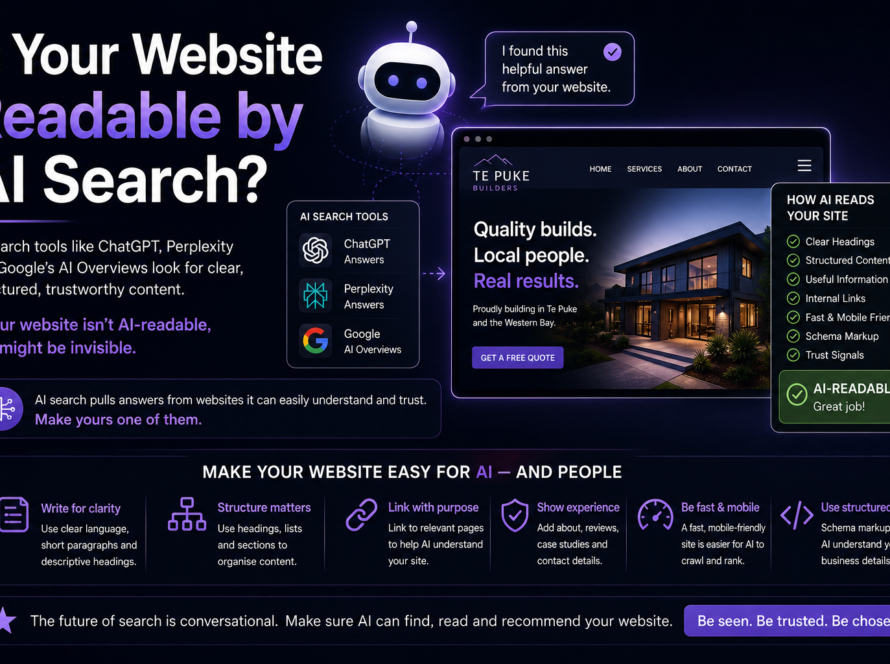
To show up in AI answers from ChatGPT, Gemini, Perplexity and Google AI Overviews, your website has to be something those engines can read clearly, trust, and quote — which comes down to clear content, solid structure, and good signals.
AI recommends what it understands
When someone asks an assistant “who does X near me?”, the AI assembles an answer from sources it has read and trusts. If your site is clear about what you do, where, and for whom — and other reputable sources back that up — you become a candidate to be named. If it’s vague or unreadable, you’re skipped.
The practical steps
- Lead with quotable answers. State plainly what you do and where, in sentences an AI can lift verbatim.
- Add structured data (schema) so engines know your business type, location and services without guessing.
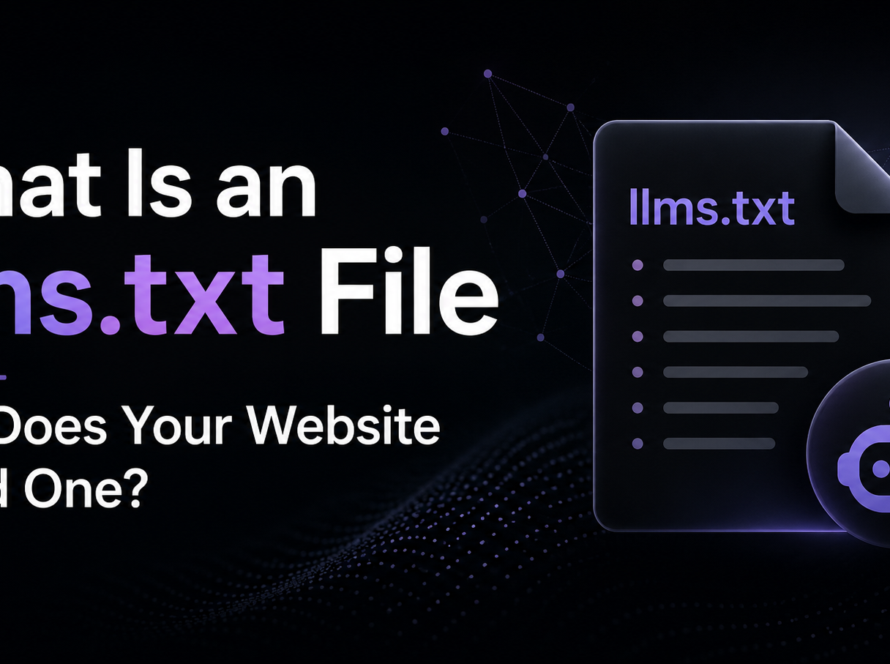
- Publish a curated
llms.txtthat summarises your business in plain language for AI crawlers. - Answer real questions with FAQ-style content — exactly the format AI loves to quote.
- Keep the site fast and server-rendered so crawlers can actually read it.
- Earn mentions on other trustworthy sites and directories.
It builds on good SEO
None of this replaces classic SEO — it extends it. A site that already ranks well and is clearly written has a big head start; GEO sharpens it for the AI era. (See SEO and GEO / AI search.)
This is our specialty — we build every site to be read by Google and AI from day one. Get an AI-readiness check and we’ll show you where you stand.
FAQ
Can I control exactly what AI says about my business?
Not exactly — but you strongly influence it by making accurate, clear, well-structured information easy to find. The cleaner your signals, the more accurate the answer.
Is this worth doing for a small local business?
Yes, often more so — local recommendation queries are common, and few small competitors are optimising for AI yet.
How do I know if it’s working?
Ask the assistants directly about your business and category, and watch referral traffic from AI tools over time.